Loading page header ... or Your browser does not support JavaScript
The 'Aluminum Dinghy' (Aludink)- Tender to "Tamara"Principal dimensions: L.O.A. 3.44 m (11' 3"), Beam 1.42 m (4' 8"), Sail area: 5.15 m2 (55 sqft). She has enough buoyancy to float after a capsize while still supporting an 10-15HP outboard motor. Buoyancy is provided by an enclosed forepeak compartment and polyethylene foam blocks under the aft thwart and the side decks. I designed and built this dinghy in 1983. Originally I had meant to build a nesting dinghy in plywood, but as I researched cruising dinghies, aluminum tenders stood out as having a lot of pluses. So I change my mind about the choice of material. To build an aluminum nesting dinghy would add complication and weight, so I investigated how I could carry a one-piece dinghy and what the maximum size might be. I found that by placing the dinghy bow to port on the foredeck, kept the anchor winch accessible and allowed me to design a long enough dinghy. |
 |
|
|
If this does not work for you, check out my nesting dinghy designs: Piccolo: 2.78 m (9'1.5") Sinbad: 3.08 m (10' 1") Dorita: 3.12 m (10' 3") Nexus: 3.32 m (10'10.7") Sinbad 2: 3.40 m (11' 1.8") Normus: 4.00 m (13'1.5") The aluminum dinghy has proven itself over and over during our circumnavigation. The toughness of the aluminum construction was a major asset. There was no need to worry about landing on any beach, or coming alongside strange docks. She has phenomenal carrying capacity. Once during our stay in the Caribbean, we went to a beach party and gave a lift to two couples from other cruising yachts in addition to our family of three. Naturally we all had picnic equipment, coolers etc. along. Still, we chugged across the lagoon with a safe amount of freeboard and as most of us sat on the side decks it was not too cramped either. For some more pics: Pictures taken during the circumnavigation on 'Tamara'. Aludink has been built by Hamish Laird for his Expedition Yacht SY 'SEAL' and named "Amazon".. Hamish and Kate Laird chartered for a long time in the Antarctic and let me have Pics of 'Amazon' sailing in the Antarctic The following link is to Hamish and Kate's facebook page. It has many more pics of the dinghy in use. The most recent while sailing the Pacific: Expedition Sail - Yacht Seal Construction: TIG welded aluminum sheet, 2,5 mm / 0.1" thick, 5052 H-34 marine grade aluminum. This made it a little heavy, but gives the boat stability. We used to carry a 15 HP Yamaha long-shaft outboard on the transom. To lift the motor off one person had to stand right at the transom. The extra weight of the dinghy helped to make this a safe operation. The dinghy is of single chine design - for simplicity of build in sheet material. The forward section of the hull panels of the boat were cut from one 8' x 4' sheet. This is made possible as topside and bottom panels run parallel where they meet along the chine near the stem. The panels only separate some distance aft of the stem. Keeping the panels joined at that point saves welding. Anyhow, the panels virtually meet in a butt joint, which is not easy to do in situ in thin sheet (This was my first time welding aluminum and therefore a bonus). The only butt joints to be welded were the extensions to the topside and bottom panels, which were welded on a backing plate, flat on the floor. The transom is 4.5mm / 0.177" thick. |
||
|
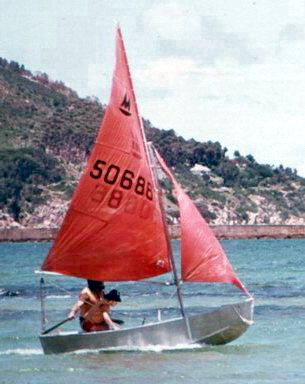
We tested the boat with a second hand suit of sails from a Mirror
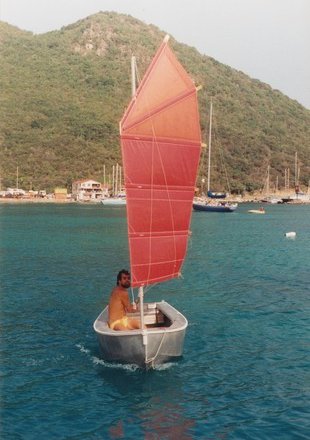
dinghy. However, for the circumnavigation we wanted a handy, small rig
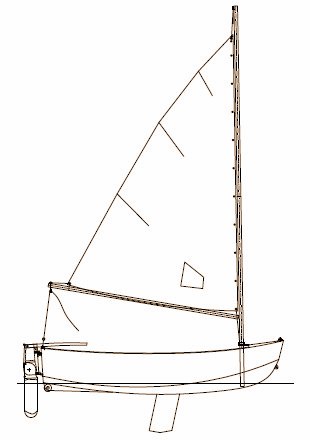
on a free standing mast, as we planned this dinghy to also fulfil a life-boat function. Having tested junk-rigs previously I had an easily adapted sail and mast for this dinghy. This worked well, but there is a lot of string to deal with and I was looking for an even handier rig. Such a rig has been developed by E.D. "Ned" McIntosh and was used by Hamish Laird, whose Aludink 'Amazon' has been sailed in the most exotic places (see the links above. Hamish used a Laser training sail with the luff recut for hoisting the sail on mast rings Ned developed for his 'Merrimac' dinghies. The mast is free-standing and has a sleeve to join the two parts and the boom is the same length, so the spars all fit inside the boat. With permission from Ned and Hamish I now supply plans with this rig. See sail plan at right. Different sail plans can be adopted. If you want to use a sail and mast you already have, I can advise on how to make it work on this dinghy. |
||
 |
 |
|
| The Aludink has a dagger board, which fits into a case that also supports the two timber thwarts.
A lifting rudder complements this for sailing in shallow
inlets, lagoons etc. Her quarters are not as full as a racing dinghy's, so she rows easily - this is important in a yacht's tender. Quite often one does not want to bother with rigging up the outboard for a short trip and of course rowing is actually quite pleasant and lets one enjoy nature. |
||
 |
||
|
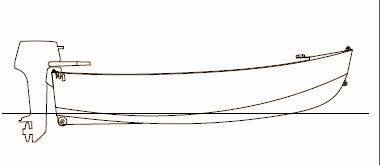
Although we used a 15 HP motor (we got it cheaply off a charter yacht in the Caribbean), the boat is quite happy with much less
power. The extra power is nice to have when using the dinghy as a 'tug',
towing the yacht. We had cause to do this when our main engine gave us trouble on the trip. By towing alongside with the 15 HP motor one has good control and can cope with wind and waves. Any long-shaft outboard from 3.3 HP up to 9.9 HP will make an acceptable power plant. |
||
Plan Prices Please read my Ordering Guide |
||
|
This project requires access to TIG welding equipment and that either you or a friend are
familiar with welding procedures. Fabricating in aluminum is quite easy as all the cutting of panels can be done by jigsaw (saber-saw). Welding equipment can be hired for the project. I built the complete aluminum hull at a friends factory over the Christmas holidays. |
Plans for this dinghy consist of two A0 (44"x33")sheets and one A1 (33"x22") sheet and building instructions This set of plans is suitable for lofting all your own panels, bulkheads and all other parts. Plan costs: €63 (+/-US$70) - which includes €13 admin (shipping) and entitles you to the building of one boat. |
|
Top of Page
Loading first page footer ... or Your browser does not support JavaScript
Loading second page footer ... or Your browser does not support JavaScript